




This package offers convenient access to a database containing 8030 accepted endemic plant taxonomic records from Peru. The records include taxa at species and infraspecific ranks, together with accepted names, family, genus, specific epithet, infraspecific taxonomy, authorship, publication details, and actual and nominal publication years.
The construction of the ppendemic package is built upon
valuable data sourced from the renowned World Checklist of
Vascular Plants (WCVP) database. The WCVP is an international
collaborative programme initiated in 1988 by Rafaël Govaerts that
provides high-quality expert-reviewed taxonomic data on all vascular
plants. As a highly authoritative resource updated daily, WCVP offers
comprehensive information on plant taxonomy and occurrence worldwide,
serving as the taxonomic backbone for World Flora Online (WFO) and being
incorporated into the Catalogue of Life Checklist via GBIF. Leveraging
this data, the ppendemic package aims to present an up-to-date and novel
compilation of Peru’s endemic plant species, tailored to the diverse
ecosystems of the region.
By incorporating meticulously curated data from WCVP following the International Code of Nomenclature for algae, fungi, and plants (ICN), this package offers users a reliable and accurate resource to explore, analyze, and gain deeper insights into the rich diversity of Peru’s endemic flora. The latest version (V-16, dated 04-06-2026) includes enhanced temporal bibliographic information with sophisticated year extraction capabilities, distinguishing between actual and nominal publication years for improved citation accuracy.
The current version expands the previously known list of 5,507 species presented in the Red Book of Endemic Plants of Peru to 8030 accepted taxonomic records. Because the database includes infraspecific taxa, this row count must not be interpreted as the number of distinct species.
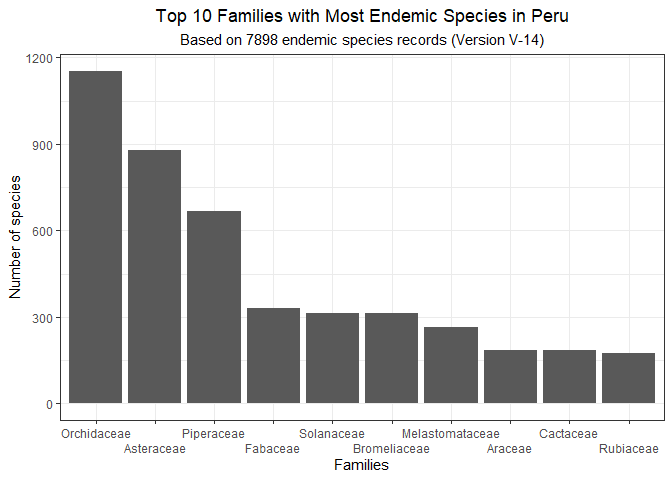
The database spans 165 families. The families with the greatest numbers of endemic taxonomic records are Orchidaceae, Asteraceae, Piperaceae, Fabaceae, Bromeliaceae, Solanaceae, Melastomataceae, Araceae, Cactaceae, Rubiaceae. The enhanced dataset also includes 159 records where actual and nominal publication years differ.
You can install the ppendemic package from CRAN
using:
install.packages("ppendemic")
# or
pak::pak("ppendemic")
Also you can install the ppendemic package from GitHub
using the following command:
pak::pak("PaulESantos/ppendemic")After installing the ppendemic package, you can load it
into your R session using:
library(ppendemic)
#> ── Access Peruvian plant endemic data ─────────────────────── ppendemic 0.2.2 ──is_ppendemic() to check if taxa are endemicsplist <- c("Aa aurantiaca",
"Aa aurantiaaia",
"Werneria nubigena",
"Dasyphyllum brasiliense var. barnadesioides",
"Miconia firma",
"Festuca densiflora")
is_ppendemic(splist)
#> [1] "Endemic" "Endemic" "Not endemic" "Endemic" "Endemic"
#> [6] "Endemic"is_ppendemic() function is designed to work
seamlessly with tibbles, allowing users to easily analyze and determine
the endemic status of species within a tabular format.
tibble::tibble(splist = splist) |>
  dplyr::mutate(endemic = is_ppendemic(splist))
#> # A tibble: 6 × 2
#>   splist                                      endemic
#>   <chr>                                       <chr>
#> 1 Aa aurantiaca                               Endemic
#> 2 Aa aurantiaaia                              Endemic
#> 3 Werneria nubigena                           Not endemic
#> 4 Dasyphyllum brasiliense var. barnadesioides Endemic
#> 5 Miconia firma                               Endemic
#> 6 Festuca densiflora EndemicTo cite the ppendemic package, please use:
citation("ppendemic")
#> To cite ppendemic in publications use:
#>
#>   Santos-Andrade PE, Vilca-Bustamante LL (2025). ppendemic: A glimpse
#>   at the diversity of Peru's endemic plants.
#>
#> A BibTeX entry for LaTeX users is
#>
#>   @Manual{,
#>     author = {Paul E. Santos Andrade and Lucely L. Vilca Bustamante},
#>     title = {ppendemic: A glimpse at the diversity of Peru's endemic plants},
#>     year = {2025},
#>     doi = {10.5281/zenodo.5106619},
#>     url = {https://paulesantos.github.io/ppendemic/},
#>   }